
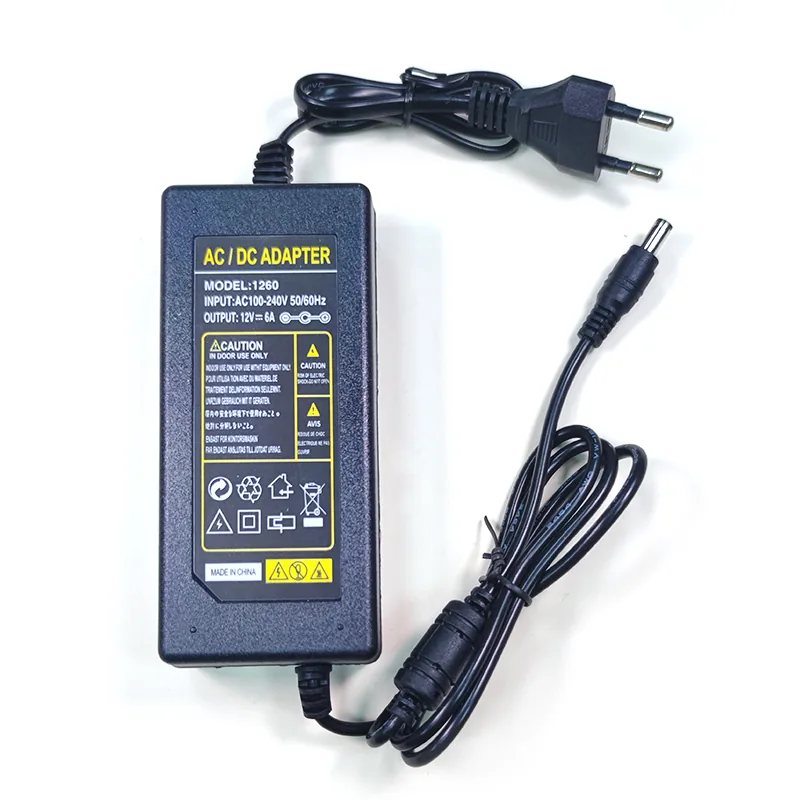
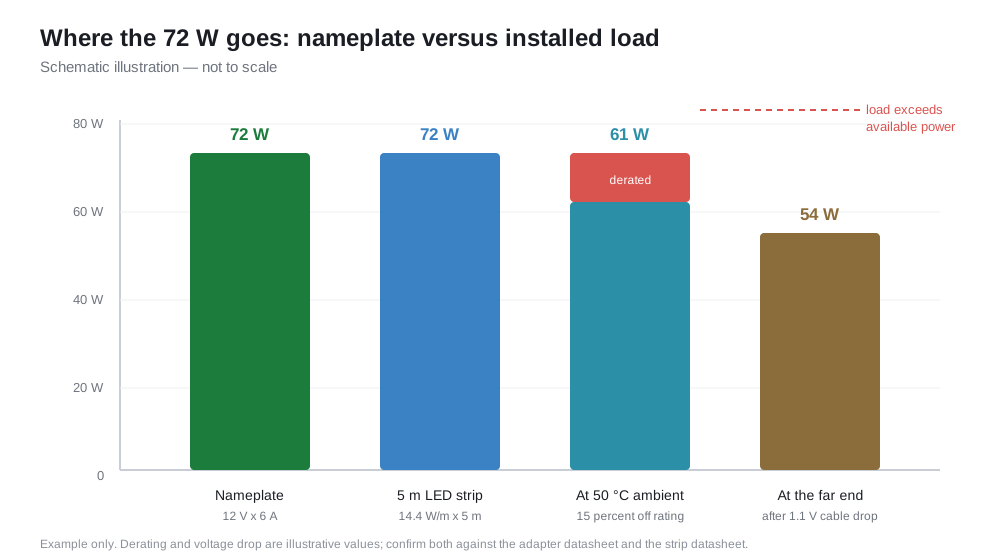
A 12 V 6 A adapter delivers 72 W. Five metres of 5050 LED strip at 14.4 W per metre also needs 72 W. The arithmetic looks perfect, the adapter is in stock, and the installation is already sitting at 100 percent of nameplate before anyone counts connector loss, a warm enclosure, or a camera that switches on its infrared array at dusk.
That gap between the number on the label and the number the load actually sees is where most 12 V projects fail. This guide walks through the sizing decisions in the order a buyer or installer meets them: what the rating really promises, whether the load wants constant voltage or constant current, how much voltage the cable eats, what CCTV cameras draw at peak, which barrel plug fits, and which marks on the case are worth reading.
1. Why a 12 V 6 A rating is not automatically enough
The current on an adapter nameplate is a rated continuous output, measured at a stated ambient temperature, with the unit mounted in its normal orientation. It is not a surge rating and it is not a promise that the adapter will hold 6 A inside a closed cabinet in summer. Three effects pull the usable number down:
- Ambient and enclosure. Adapter datasheets publish a derating curve. A typical 60 W desktop series is specified from −30 to +70 °C but only reaches full load at the lower end of that range; above the knee the permitted load falls with temperature (Mean Well GST60A series datasheet, 2022-11-21). Inside a sealed box the local ambient is higher than the room.
- Conversion loss. A 72 W output at about 89 percent efficiency pulls roughly 81 W from the wall, and the difference leaves as heat inside the same plastic case that is trying to stay cool.
- Delivery loss. The adapter may hold 12.0 V at its own plug, but the strip or camera sees 12.0 V minus the drop in the lead, the barrel contact and any extension cable.
Engineering practice is to size continuous loads at 70 to 80 percent of the rated output, then check the derating curve at the real ambient. That rule is a convention rather than a clause in a standard, so treat it as a starting point and let the datasheet decide. What matters commercially is that the number you write on the purchase order is the number the installation will draw on its worst night, not its average evening.
Load budget worksheet
Build the budget in watts and in amps, because both get quoted. The table below uses the two loads this article is about, at the values published in the datasheets cited further down.
| Load | Nameplate or datasheet draw | Continuous current at 12 V | What to add before sizing |
|---|---|---|---|
| 5 m of 5050 strip, 60 LEDs/m | 14.4 W/m × 5 m = 72 W | 6.0 A | 20–30 percent headroom; cable drop on the feed |
| 5 m of 3528 strip | 4.8 W/m × 5 m = 24 W | 2.0 A | Headroom; the strip itself drops voltage along its PCB |
| Fixed 12 V CCTV camera | Typically 12 V, 1 A class | 1.0 A | IR array peak, heater, long DC run |
| PTZ or dual-lens camera | 12 V, 2 A class | 2.0 A | Motor inrush during pan and tilt |
| PoE camera on 802.3af | 15.4 W at the PSE, 12.95 W at the device | n/a (48–57 V) | Not a 12 V load; do not mix the two budgets |
The PoE row matters because it is often quoted as if it were a 12 V figure. IEEE 802.3af allows 15.4 W at the power sourcing equipment and guarantees 12.95 W at the powered device over the cable; 802.3at raises those figures to 30 W and 25.5 W (Type 2 port limits as summarised in RF Wireless World, 2026-03-28). A 12 V adapter feeding the same camera through a barrel jack is a different calculation entirely.
2. Constant voltage or constant current: match the driver to the load
A constant voltage (CV) supply holds its output voltage steady and lets the load draw whatever current it needs. A constant current (CC) driver does the opposite: it adjusts its output voltage up and down to force a fixed current through the load. The distinction is not marketing language, it is the difference between a load that limits its own current and one that does not.
Constant voltage loads include LED strip with series resistors built into each cuttable segment, 12 V cameras, routers, monitors and set-top boxes. The strip is designed for a fixed 12 V rail, and the resistor in each segment sets the current. Constant current loads include bare high-power LED modules, COB arrays and luminaires built from series strings without per-string resistors. Those need a driver that regulates current, because the LED forward voltage shifts with temperature and a fixed voltage would let the current run away.
The practical consequence for a buyer is simple. If the datasheet says 12 V DC and quotes watts per metre, it is a CV load and a 12 V adapter is correct. If the datasheet quotes a drive current such as 700 mA or 1050 mA and a forward voltage range such as 30–36 V, it is a CC load and an adapter is the wrong product. LEDSupply's comparison of CC and CV drivers (2019-02-05) puts the same rule in one line: a strip that says 12 V DC needs a 12 V constant voltage source, not a constant current driver.
Where buyers get caught is the word "driver". In the lighting trade, "LED driver" is often used for any box that powers a strip, including a CV adapter. In a purchase order, spell out the mode, the voltage and the current, and the ambiguity disappears.
3. LED strip power per metre, and the voltage drop that eats it
Strip power is quoted per metre, and the number varies widely with LED size and density. A mainstream 5050 strip with 60 LEDs per metre is rated at 14.4 W per metre in supplier datasheets, and the same datasheet recommends an 18 W per metre power supply — a built-in 25 percent margin (5050 RGB strip datasheet, CDNLUX, undated supplier document). A lower-density 3528 strip is commonly around 4.8 W per metre; Waveform Lighting uses exactly that figure in its worked example, where a 5 m reel draws 24 W or 2.0 A at 12 V (Waveform Lighting, undated technical article).
Now the part that a power calculation alone will miss. The strip is a long, thin conductor. Current entering at one end travels through the copper traces of the PCB, and every metre of trace has resistance, so the voltage at the far end is lower than at the feed point. The drop is not a defect; it is arithmetic:
Vdrop = 2 × L × I × R, where L is the one-way run length in metres, I is the current in amps and R is the conductor resistance in ohms per metre. The factor of two accounts for the outbound and return conductors. This is the same formula used in low-voltage lighting calculators (LEDZONE voltage drop calculator, undated).
Copper resistance by gauge is well documented. At 20 °C, 20 AWG copper is 33.31 mΩ per metre, 18 AWG is 20.95 mΩ/m and 16 AWG is 13.17 mΩ/m (American wire gauge table, accessed 2026-11-02). Put those numbers into the formula and the results explain most "my strip is dim at the end" complaints:
| Conductor | 2 A over 5 m | 5 A over 5 m | 2 A over 10 m |
|---|---|---|---|
| 20 AWG (0.52 mm²) | 0.67 V (5.6%) | 1.67 V (13.9%) | 1.33 V (11.1%) |
| 18 AWG (0.82 mm²) | 0.42 V (3.5%) | 1.05 V (8.7%) | 0.84 V (7.0%) |
| 16 AWG (1.31 mm²) | 0.26 V (2.2%) | 0.66 V (5.5%) | 0.53 V (4.4%) |
Assumptions: copper conductors at 20 °C, DC, resistive load, one-way length shown, connector and PCB trace resistance excluded. In practice the strip's own traces add more drop, which is why installers treat 5 m as the practical limit for a single 12 V feed and about 10 m for 24 V. The 24 V strip at the same wattage draws half the current, so the same conductor loses half the volts (Yuji Lighting, 12V vs 24V LED strip, 2022-07-07). The 5 m and 10 m figures are installer practice rather than a published standard; treat them as a starting assumption and measure the far end under load.
Two design moves fix a long run without changing the adapter. Feed both ends of the strip (or inject power every 5 m) so each half carries half the current, and use a heavier feeder cable between the adapter and the first strip segment. Both reduce the current in the highest-resistance section, which is where the drop is generated.
4. CCTV peak current and centralised 12 V power
A fixed 12 V camera is usually a 1 A class device, and a PTZ or dual-lens model is typically a 2 A class device; Reolink's 12 V camera guide describes adapters in exactly those terms and notes that a 2 A adapter is safe on a 1 A camera because the camera draws only what it needs (Reolink, 2026-08-20). That is correct for the camera, and it is the reason a bigger adapter is not dangerous. It is not a reason to skip the peak calculation.
The load that ruins a 12 V CCTV budget is the infrared illuminator. A camera that draws 4 W in daylight can pull considerably more when the IR array switches on, and the switch-on is a step, not a ramp. Add a heater or a wiper on an outdoor housing and the peak climbs again. If four 1 A cameras share one 12 V 6 A box, the continuous load is already 4 A, leaving 2 A for every IR step, every motor start and every volt lost in the cable.
Centralised boxes are usually built with per-channel fuses or PTC devices, which protect the wiring but do not create current. The number that matters is the voltage at the camera terminals at night, not the voltage at the box output at noon. A 20 m run of 20 AWG at 1 A loses about 1.3 V, which takes a 12.0 V output down to 10.7 V — enough to cause reboot loops or failed night vision on a marginal camera. Use 18 AWG or thicker for runs beyond about 15 m, or move the power source closer, as Reolink also recommends for long 12 V runs.
Two more practices separate a reliable cabinet from a service call. First, distribute rather than concentrate: two 12 V 5 A supplies with separate feeds fail gracefully, while one 12 V 10 A supply with a single output takes every camera down together. Second, leave the switching supply somewhere it can breathe. A 72 W adapter in a sealed plastic enclosure is a 72 W heater in the same box as the NVR.
5. Barrel plugs: same outside, different inside
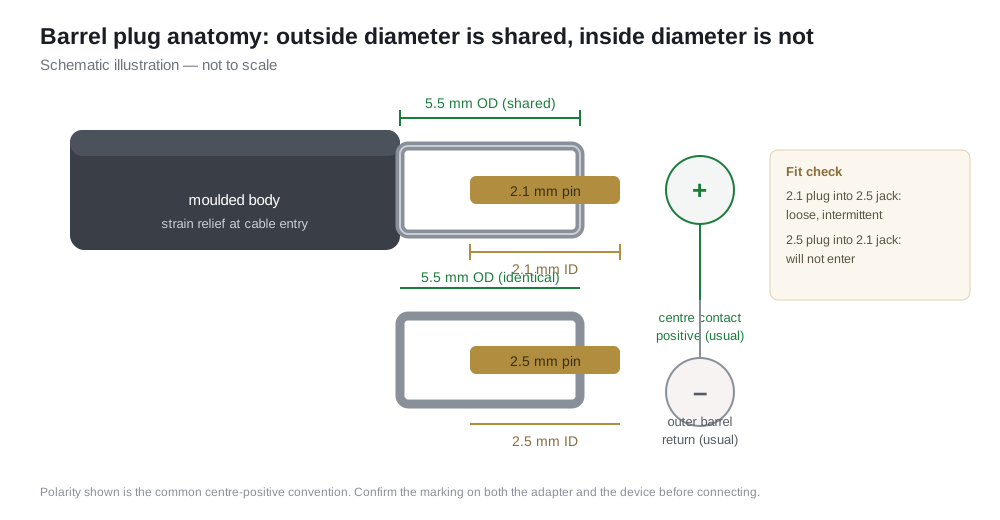
The DC barrel connector is the least documented part of most 12 V systems, and the one most likely to generate a return. The two connectors in this market share an outside diameter of 5.5 mm, so they look identical in a photograph and feel similar in the hand. The inside diameter is the difference: 2.1 mm or 2.5 mm. A 2.1 mm plug pushed into a 2.5 mm jack makes contact only on the spring fingers, with less pressure and more resistance; a 2.5 mm plug simply will not enter a 2.1 mm jack. Waveform Lighting warns buyers directly that a 5.5 × 2.5 mm plug may not work with LED strip connectors (Waveform Lighting), and Assured Systems describes the 2.1 × 5.5 mm part as the common choice for routers, CCTV cameras and LED strip, usually wired centre-positive (Assured Systems FAQ, undated).
Polarity is the second trap. Centre-positive is the convention for most consumer 12 V equipment, but it is a convention, not a law: centre-negative devices exist, and reversing polarity on a camera or a strip controller can destroy the input stage in seconds. Read the symbol printed next to the jack — a dot connected to the centre with a plus sign, and a broken circle connected to the outer barrel with a minus sign — and check it against the adapter label before the first connection.
| Connector | Outside diameter | Inside diameter | Where it is common | Purchase note |
|---|---|---|---|---|
| 5.5 × 2.1 mm | 5.5 mm | 2.1 mm | LED strip, CCTV cameras, routers, small monitors | Most common; specify centre-positive unless the device says otherwise |
| 5.5 × 2.5 mm | 5.5 mm | 2.5 mm | Some CCTV kits, CB radio, older networking gear | Will not mate with a 2.1 mm jack; measure before ordering |
| 3.5 × 1.35 mm | 3.5 mm | 1.35 mm | Compact cameras, small hubs, mini PCs | Not interchangeable with 5.5 mm parts in any dimension |
| 2.5 × 0.7 mm | 2.5 mm | 0.7 mm | Thin devices, some tablets and shavers | Low current only; do not use for strip or camera loads |
Contact resistance deserves a paragraph of its own, because it is invisible until it is hot. A barrel contact is a spring finger pressing on a plated tube. Its resistance depends on contact pressure, plating, surface oxide and how many mating cycles the parts have seen. As resistance rises, the contact dissipates power locally, the plating oxidises faster, resistance rises again, and the plug body discolours. The failure mode is a warm plug and an intermittent device long before anything looks burnt. A connector rated for 7.5 A in a catalogue is rated as a new part under test conditions; an aged plug in a humid outdoor box is not that part.
For OEM orders, the connector should be a line item, not an assumption: outside diameter, inside diameter, length, straight or right-angle, centre polarity, plating and cable length. Our 12 V 6 A desktop power adapter is built with a fixed DC lead and a barrel plug, and the plug type is one of the specifications we confirm per order rather than a default.
6. Efficiency, no-load power and what the marks actually promise
Three efficiency regimes matter for a 12 V adapter sold into export markets, and they are often confused in quotations.
- US DoE Level VI, in force since February 2016: for a standard-voltage adapter between 49 W and 250 W, average active efficiency must be at least 0.880, and no-load power at most 0.210 W. Below 49 W the active efficiency formula is 0.071 × Pout + 0.67 and no-load is capped at 0.100 W (Bel/CUI technical paper, 2020-04-01, summarising 10 CFR 430).
- EU Regulation (EU) 2019/1782, applicable from 1 April 2020, harmonised the EU with Level VI for standard-voltage adapters: at least 0.880 average efficiency and at most 0.210 W no-load in the 49–250 W band (same source).
- EU Code of Conduct Tier 2 is voluntary but stricter: 0.890 average efficiency, 0.790 at 10 percent load, and no-load at or below 0.150 W in the 49–250 W band. It also adds a 10 percent load efficiency requirement that Level VI does not have (same source).
The regime is moving again. Commission Regulation (EU) 2025/2052 of 13 October 2025 replaces 2019/1782 and applies from 14 December 2028, with voluntary early compliance allowed before then (GMA Consult Group regulatory note, 2026-02-17). A buyer signing a two-year supply agreement in 2026 should ask whether the platform is already designed against the new regulation, because the adapter you qualify this year may need requalification before the contract ends.
What the numbers mean in a real cabinet: a 72 W output at 89 percent efficiency draws about 81 W and releases roughly 9 W as heat. No-load power decides the standby bill. At 0.21 W, a permanently connected adapter consumes about 1.8 kWh a year; at the 0.075 W that better desktop platforms achieve, the same adapter consumes about 0.66 kWh. Neither number is large for one unit, but multiplied across a retail chain's camera estate it becomes a line in the energy budget, and EU buyers increasingly ask for it in writing.
7. Temperature rise and derating
Derating is the least glamorous specification and the one that decides field life. It is published as a curve: permitted load on the vertical axis, ambient temperature on the horizontal. The curve usually stays flat to a knee and then falls, and the knee is often well below the maximum rated ambient. A series rated from −30 to +70 °C can be specified at full load only in the lower part of that window; above the knee, the same case must deliver less (Mean Well GST60A datasheet, 2022-11-21).
Two practical consequences follow. First, the ambient that matters is the air around the adapter, not the room. Inside a metal cabinet with an NVR and a switch, or inside a closed pelmet with an LED strip, the local temperature can sit 10–15 °C above the room. That estimate is a field rule of thumb rather than a measured standard, so measure it if the margin is thin. Second, heat ages electrolytic capacitors, and the long-standing engineering rule of thumb is that every 10 °C reduction roughly doubles capacitor life. Treat that as a rule of thumb, not a warranty, but it explains why the same adapter lasts years on an open shelf and months in a sealed box.
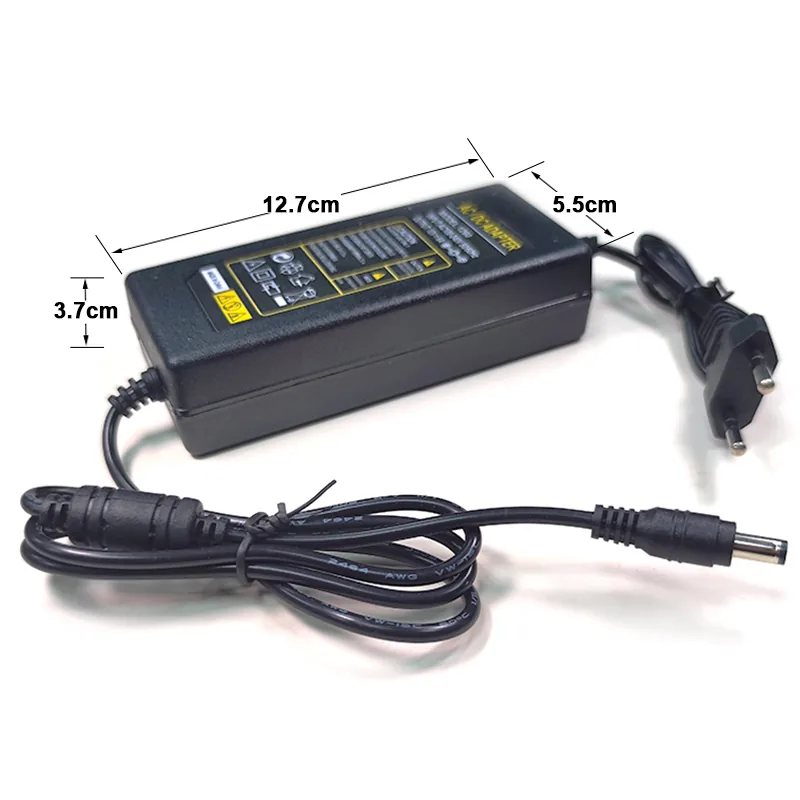
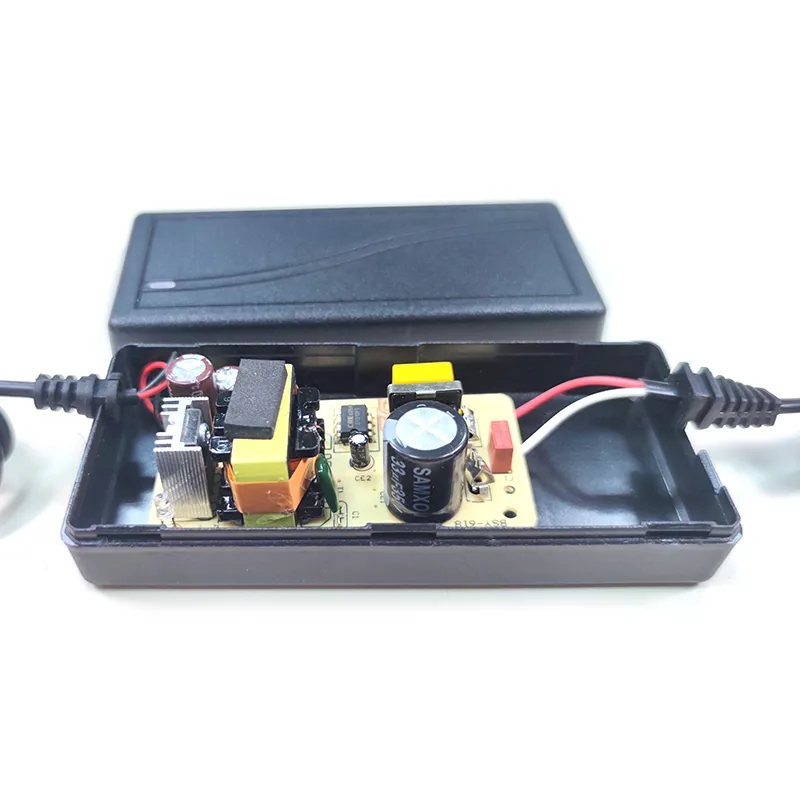
Our 12 V 6 A desktop adapter is a convection-cooled plastic-case design, so the installation instructions matter as much as the rating: stand it on its base, keep the vents clear, and do not bury it under cable bundles. Where the enclosure is sealed, the honest answer is to size the next model up rather than to argue with the curve.
8. Reading the safety marks: IEC 62368-1 and what sits behind CE
External power supplies for audio, video, information and communication equipment are now assessed against IEC 62368-1, the hazard-based standard that replaced IEC 60950-1 (IT equipment) and IEC 60065 (audio/video equipment). The current edition is IEC 62368-1:2023, published on 26 May 2023 and included in the IECEE system from 21 June 2023, with CENELEC adopting it as EN IEC 62368-1:2024 + A11:2024 (IECEE standard page, accessed 2026-11-02). The superseded standards were withdrawn on 20 December 2020, which is the date buyers still see quoted in older supplier certificates (Bel/CUI introduction to IEC 62368-1, 2018-09-21).
A certificate that names only IEC 60950-1 is not automatically invalid for goods already on the market, but it is a signal that the platform has not been refreshed. For a new order in 2026, ask for the standard and the edition, not just the acronym.
On the case, the useful items are:
- Input range and frequency — for example AC 100–240 V, 50/60 Hz. A narrow 220–240 V label will not survive a US or Japanese socket.
- Output — voltage, current and the polarity symbol, printed together. If the current is missing, the rating is incomplete.
- Ambient rating — a ta or Ta value, or a reference to the derating curve in the datasheet.
- Protection class — Class II (double square) or Class I with a protective earth. A two-wire AC plug cannot be Class I.
- Safety and EMC marks — CE for the EU, UKCA for Great Britain, UL or ETL for North America, plus the CB report reference if the supplier can share it.
- Ingress protection — an IP rating if the adapter is offered for outdoor or damp locations. Most desktop adapters are not.
CE marking is a declaration, not a certificate. For an adapter it normally rests on the Low Voltage Directive 2014/35/EU, the EMC Directive 2014/30/EU and the RoHS Directive 2011/65/EU, supported by test reports. Our 12 V 6 A desktop adapter is listed on this site as certified to LVD EN IEC 62368-1 and EMC EN 55032, with RoHS compliance; if your market needs UL, UKCA or a CB report, that belongs in the enquiry rather than in the assumption.
9. Naming and perception traps
Most sourcing mistakes on 12 V adapters are not technical failures. They are misread names. Five traps account for a large share of them.
Trap 1: "6 A" treated as a peak rating. The nameplate current is a continuous rating at a stated ambient. It is not a surge allowance, and it is not a number the adapter can hold in a hot cabinet. The related mistake is the reverse: assuming a 6 A adapter pushes 6 A into a 2 A load. It does not; the load draws what it needs, and the extra capacity simply stays unused (Waveform Lighting makes the same point about 36 W supplies on 24 W strips).
Trap 2: "12 V" treated as exactly 12.000 V. Regulated adapters hold a tolerance band. A desktop series may be specified at ±3 percent, which puts a 12 V unit anywhere from 11.64 V to 12.36 V, and an unloaded unit often sits near the top of the band (Mean Well GST60A datasheet, 2022-11-21). A strip that is already marginal on voltage drop will look different at 12.36 V than at 11.64 V.
Trap 3: "5.5 mm plug" treated as one part number. The outside diameter is shared; the inside diameter is not. A purchase order that says only "5.5 mm DC plug" leaves the supplier to choose, and the wrong choice produces a plug that fits loosely, heats up, or falls out.
Trap 4: a constant voltage adapter used as an "LED driver". The label says LED, the box says adapter, and the load is a bare COB array with no series resistor. The current rises with temperature, the array overdrives, and the failure is blamed on the LEDs rather than on the driver topology.
Trap 5: the same case, two ratings. Desktop adapter families often share one enclosure across several power levels, so a 60 W and a 90 W model can look identical from the outside. Never infer the rating from the case: read the label, and match the label to the certificate and the purchase order.
10. The purchase order checklist
An adapter specification that survives a factory change, a market-surveillance check and a customer complaint fits on one page. The table below is the minimum set of lines worth writing into a PO for a 12 V LED strip or CCTV project.
| PO line | What to write | Why it matters |
|---|---|---|
| Output | 12 V DC, rated current, rated power, tolerance band | Prevents a 5 A platform being shipped against a 6 A order |
| Load definition | Continuous load in A, peak load in A and duration, ambient temperature | Derating and headroom can only be checked against a stated load |
| Input and plug | AC range, frequency, plug pattern per market (EU, US, UK, AU), cable length | One SKU cannot serve every market without a plug change |
| DC connector | 5.5 × 2.1 mm or 5.5 × 2.5 mm, length, straight or right-angle, centre polarity, current rating | The most common source of returns and field failures |
| Efficiency | Level VI, 2019/1782 or CoC Tier 2, with the test report reference | A logo is not evidence; the report is |
| Safety | EN IEC 62368-1 (edition), EN 55032, RoHS, plus UL/UKCA/CB if required | Defines the compliance file you can hand to a customer |
| Marking | Label artwork, model number, ta value, country of manufacture, language of the manual | Market surveillance reads the label first |
| Reliability | Aging or burn-in requirement, hi-pot test, visual criteria, AQL | Turns "good quality" into an inspectable clause |
Practical checklist before you release the order
- Measure the device jack with a calliper, or test-fit a known 2.1 mm and 2.5 mm plug. Record which one fits.
- Add the continuous loads, then add the peak loads separately. Size the adapter on the peak, then confirm the continuous load stays under about 80 percent of the rating.
- Check the derating curve at the real ambient inside the enclosure, not the room temperature.
- Calculate the drop for the longest run at the highest current, and confirm the voltage at the far end is still inside the device's input range.
- Confirm polarity from the device marking and repeat it on the PO.
- Ask for the efficiency test report and the safety certificate with the edition named.
- Ask for a production label photo and check it against the PO line by line.
- For outdoor work, specify a sealed joint, a drip loop and a housing; a desktop adapter is not an outdoor product.
11. Common mistakes and their consequences
| Mistake | What happens | How to prevent it |
|---|---|---|
| Sizing at 100 percent of nameplate | Adapter runs hot, output sags under peak, life shortens; in a sealed box it may shut down on overload | 70–80 percent continuous loading, checked against the derating curve |
| Ignoring IR peak current on CCTV | Cameras reboot at dusk, night vision fails, recordings drop out for a few seconds every evening | Budget the peak, not the average; measure voltage at the camera at night |
| 2.1 mm plug in a 2.5 mm jack | Intermittent contact, warm plug, device resets when the cable is touched | Specify the inside diameter and test-fit before the order |
| Reversed polarity | Dead camera or dead strip controller; not covered by most warranties | Read the polarity symbol on both parts; mark the PO |
| Long thin extension on a 12 V run | Dim strip at the far end, camera undervoltage, wasted watts in the cable | Heavier feeder, double-ended feed, or 24 V strip for long runs |
Sources
- IECEE, IEC 62368-1:2023 standard page, issue date 2023-05-26, accessed 2026-11-02.
- Bel/CUI, IEC 62368-1: An Introduction to the New Safety Standard for ICT and AV Equipment, 2018-09-21.
- Bel/CUI, Efficiency Standards for External Power Supplies (Level VI, Ecodesign 2019/1782, CoC Tier 2 tables), 2020-04-01.
- GMA Consult Group, EU Adopts New Ecodesign Regulation for External Power Supplies (Regulation (EU) 2025/2052, applicable 2028-12-14), 2026-02-17.
- Mean Well, GST60A series datasheet (12 V 5 A, derating curve, 16 AWG lead, P1J plug), 2022-11-21.
- CDNLUX, RGB 5050 LED strip, 60 LEDs/m datasheet (14.4 W/m, 18 W/m supply recommendation), undated supplier document.
- Waveform Lighting, How to choose a power supply for your LED strip project (3528 strip at 4.8 W/m; 5.5 × 2.5 mm warning), undated.
- Yuji Lighting, 12V vs 24V LED Strip (current halved at 24 V for the same wattage), 2022-07-07.
- LEDZONE, Voltage drop calculator (V = 2 × length × current × resistance), undated.
- Wikipedia, American wire gauge (copper resistance per metre by gauge), accessed 2026-11-02.
- Reolink, 12V Security Camera Guide 2026 (1 A and 2 A adapter classes, long-run voltage drop), 2026-08-20.
- RF Wireless World, Power over Ethernet: Type 1 to 4 (802.3af 15.4 W / 12.95 W; 802.3at 30 W / 25.5 W), 2026-03-28.
- Assured Systems, What is a DC 2.1 x 5.5 mm connector? (typical applications, centre-positive convention), undated.
- LEDSupply, Constant Current vs Constant Voltage LED Drivers, 2019-02-05.
Related products from Vellygood
- 12 V 6 A Desktop Power Adapter — 110–250 V input, customizable AC plug and output specification, LVD EN IEC 62368-1 and EMC EN 55032
- EU Plug to C13 Desktop Power Cord — 3 × 0.3 mm², 1.5 m, for the AC side of a desktop adapter
- CAT.6 UTP Patch Cord — for the data side of an IP camera installation
Conclusion
Sizing a 12 V adapter is not a matter of matching one number. It is a chain of four checks: the continuous and peak current the load will really draw, the voltage the load will really see at the end of the cable, the temperature the adapter will really sit in, and the connector that will really fit. A 12 V 6 A unit is a sensible choice for a 2 A camera or a 24 W strip. For 5 m of 14.4 W/m strip it is a 100 percent load before derating, which is why the same 72 W of strip is usually better served by a larger supply or by splitting the run.
None of these checks requires a laboratory. A calliper, a multimeter, a datasheet and a purchase order with the right eight lines will prevent most of the failures described here. What it does require is treating the nameplate as the start of the calculation rather than the end of it.