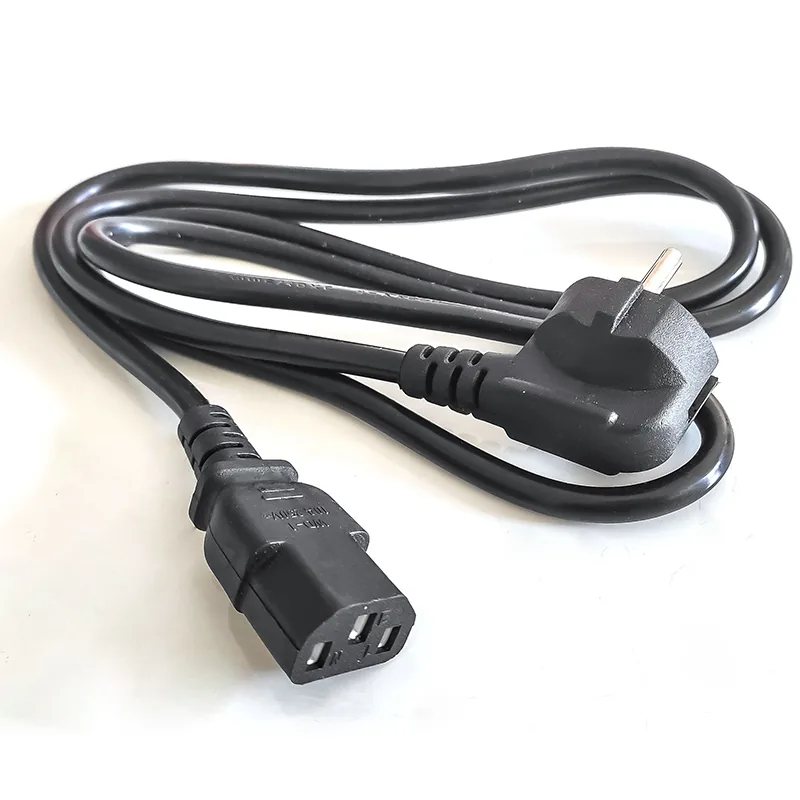
Almost every appliance cord set that crosses a border is built around one small moulded part: an IEC 60320 coupler. It is the connector at the appliance end, and it is where most sourcing mistakes start. A buyer sends a photograph of a "kettle lead", receives a container of C13 cords, and discovers on arrival that the appliance has a C16 inlet with a keying notch, a C19 inlet rated 16 A, or a C6 cloverleaf inlet on a 90 W adapter.
The coupler is also the part buyers describe least precisely. "Standard power cord" covers at least five different interfaces with different current ratings, different maximum pin temperatures and different mating keys. This guide gives you a repeatable three-step method for fixing the specification, a comparison of the five couplers that cover the great majority of orders, the plug patterns you will be asked for by market, and the exact lines to write into a purchase order so the goods match the quotation.
1. The three-step method: inlet, current, temperature
Work backwards from the appliance, not forwards from the plug. The appliance inlet is a fixed mechanical fact; the plug pattern is a market decision; the cord in between is the variable you are buying. Fixing the inlet first removes most of the ambiguity.
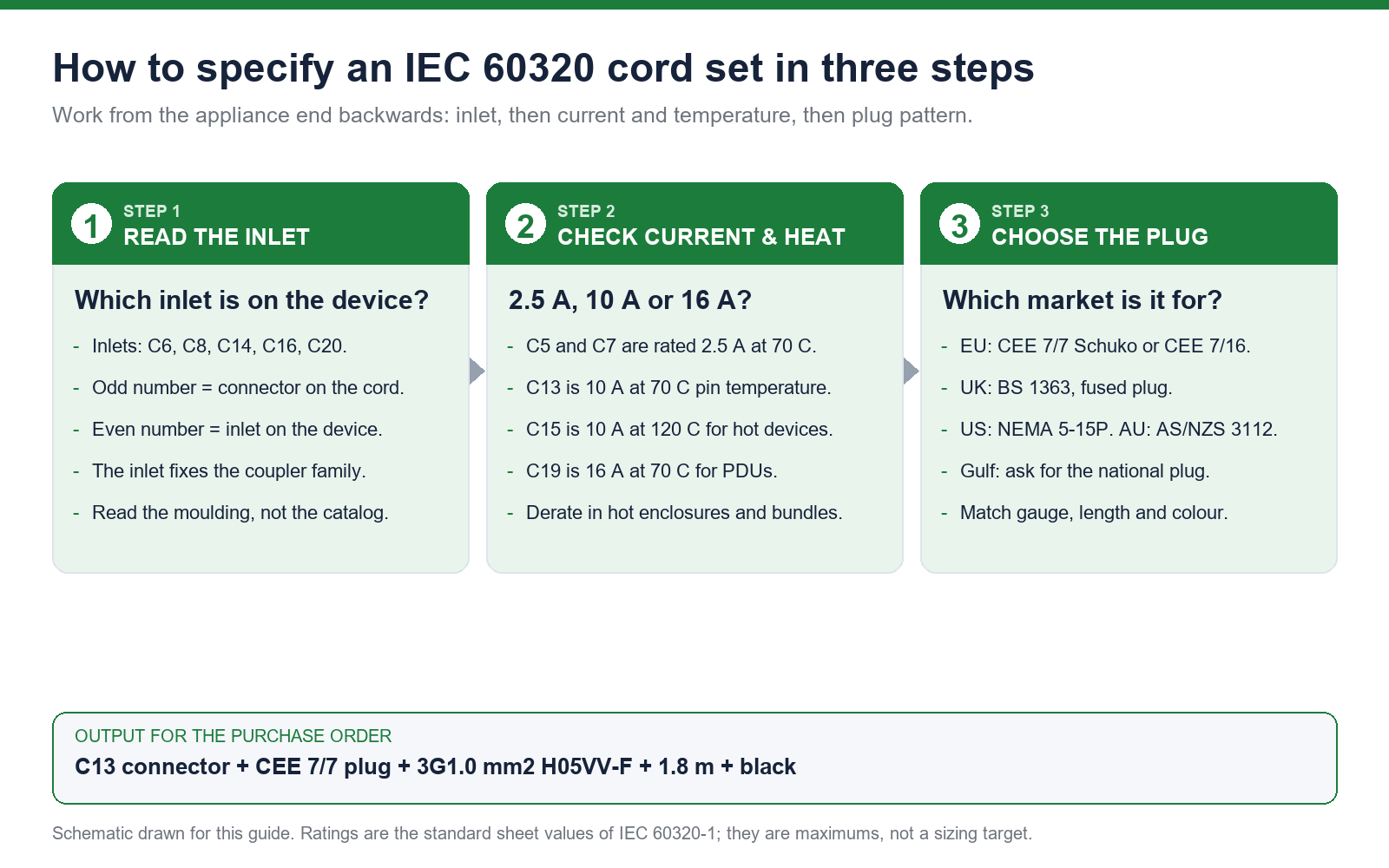
Step one is mechanical: identify the male inlet moulded into the appliance. Step two is thermal and electrical: read the inlet marking or the appliance nameplate for current and check whether the appliance runs hot enough to need the 120 °C variant. Step three is commercial: choose the plug half for the destination market, then size the conductors for the current from step two. Buyers who start at step three, usually because the customer sent a photo of a wall socket, end up reverse-engineering the coupler from a plug and guessing at the rest.
2. What the C numbers actually mean
IEC 60320-1 is the base standard for appliance couplers, and each interface has its own standard sheet that fixes the dimensions, the contact arrangement and the rating. Two conventions do most of the work in reading a catalogue:
- Odd numbers are connectors. The C13, C15 and C19 are the female connectors moulded onto the end of the cord. They are what you plug into the appliance.
- Even numbers are inlets. The C14, C16 and C20 are the male inlets built into the appliance chassis. They are the fixed half and they are not something a cord supplier can change.
So a "C13 power cord" is a cord set with a C13 connector at one end and a wall plug at the other; the appliance it serves has a C14 inlet. That vocabulary matters when a customer writes "C14 cord", which is not a thing you can ship: the C14 is the inlet on their product, and what they need from you is the C13 connector that mates with it.
The naming is also where the trade nicknames mislead. "Kettle lead" is used for both C13 and C15 cords, which are not interchangeable on a hot appliance. "Mickey Mouse" or "cloverleaf" means C5. "Figure-8" or "shotgun" means C7. None of these names carries a current rating, and none of them tells you whether the appliance needs an earth connection.
3. The five couplers that cover most orders
The table below is the specification summary. The ratings are the standard sheet values of IEC 60320-1; the cord column is a typical construction, not a requirement of the coupler standard, and the final conductor size should follow the appliance current and the cord standard you are building to.
| Coupler (connector / inlet) | Rated current (IEC) | Max pin temperature | Typical appliance | Typical cord |
|---|---|---|---|---|
| C5 / C6 — cloverleaf | 2.5 A | 70 °C | Notebook and small IT power supplies, projectors, chargers | 3-core, 0.75 mm², H05VV-F |
| C7 / C8 — figure-8 | 2.5 A | 70 °C | Class II audio gear, set-top boxes, small adapters (no earth) | 2-core, 0.75 mm², H03VVH2-F |
| C13 / C14 | 10 A | 70 °C | Desktop PSUs, monitors, test equipment, IT hardware | 3-core, 0.75–1.0 mm², H05VV-F |
| C15 / C16 | 10 A | 120 °C | Kettles, urns, coffee machines, warming appliances | 3-core, heat-resistant, 1.0 mm² |
| C19 / C20 | 16 A | 70 °C | Rack PDUs, servers, UPS units, large power supplies | 3-core, 1.5 mm², H05VV-F |
Two adjacent families are worth knowing because they appear in RFQs but are often mislabelled: C17/C18 is a 10 A two-contact pair without an earth, used on double-insulated IT equipment where a C13 body would be too large; C21/C22 is a 16 A pair rated for a 155 °C pin temperature, used on high-heat commercial equipment. Neither is a substitute for the five above, and neither should be offered as an upgrade without checking the inlet on the appliance.
4. C13 versus C15 versus C19: where the family splits
The three couplers look similar enough in a photograph that buyers treat them as one product with three prices. They are three different specifications, and the differences are mechanical, thermal and electrical at the same time.
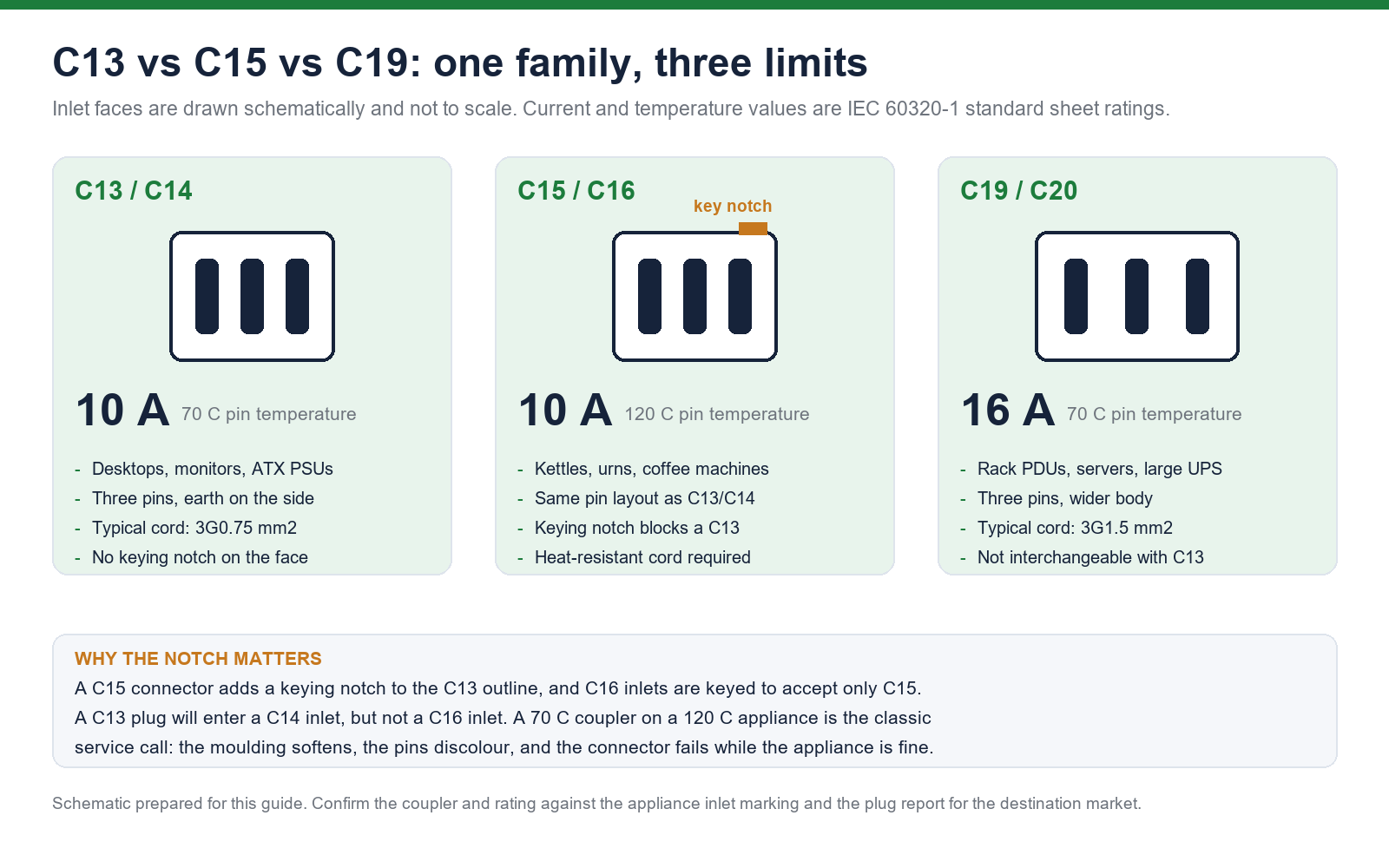
C13 is the general-purpose 10 A connector. Three contacts, 70 °C maximum pin temperature, and the shape most offices would recognise. Its limit is thermal: the moulding and the cord behind it are designed for an appliance that does not run its inlet hot.
C15 is the same layout with a 120 °C rating and a key. The extra notch in the mating face is not cosmetic. C16 inlets are keyed to accept only a C15, so a C13 cannot be pushed into a 120 °C appliance by mistake. A C15 will still mate with an ordinary C14 inlet, which is why the substitution is common in the other direction, and why a purchasing department that buys C15 for everything pays a premium for a feature most of its orders do not need.
C19 is the 16 A connector, with a wider body and larger contact spacing, used on rack PDUs, servers and UPS outlets. It is not a heavy-duty version of the C13 that fits the same hole: a C19 will not enter a C14 inlet and a C13 will not enter a C20. Its 16 A rating is also the reason the cord behind it is normally 1.5 mm² rather than 0.75 mm².
Polarity deserves its own line in the inspection checklist. All three couplers assign fixed positions to line, neutral and earth, and a cord wired with line and neutral reversed will still mate, still power the appliance, and still pass a continuity check that only looks for opens. On a UK plug the fuse sits in the line conductor, so a reversal puts the fuse in the neutral path and leaves the appliance live upstream of the protection. Ask for the wiring schedule and check a sample against it, not just for continuity.
5. Current rating is not a continuous-duty promise
The number in the table is a maximum under the conditions the standard tests, with a stated pin temperature limit. It is not a promise that a 10 A C13 will carry 10 A indefinitely in any enclosure.
Three effects erode the margin. First, ambient temperature: a 70 °C pin temperature rating assumes the heat has somewhere to go, and an inlet inside a closed cabinet, next to a transformer, has nowhere to go. Second, bundling: cords laced together in a rack or a cable tray heat each other, and the derating for grouped cables is a normal part of installation practice for a reason. Third, conductor size: a 0.75 mm² cord at 10 A is a legal construction in many markets, but it leaves very little thermal headroom compared with 1.0 mm².
The practical rule for a B2B order is to ask what the continuous load will be, not what the connector is rated for. If the answer is "close to the rating", specify the next conductor size up and confirm the ambient. This is also the point where a 30 °C ambient in a Middle East warehouse or a server room becomes a specification item rather than a footnote. Buyers who treat "10 A" as an absolute number are the ones who receive discoloured pins six months later and blame the moulding.
6. Plug patterns by market
The plug half of the cord set is decided by the destination, and the combinations that reach a factory are predictable. What matters is that the plug's own rating does not contradict the coupler's.
| Plug pattern | Standard / family | Main markets | What to check on the PO |
|---|---|---|---|
| CEE 7/7 Schuko hybrid | CEE 7 family, earthed two-pin | Germany, France, Netherlands, most of continental EU, Gulf markets | Earth clips present, plug report on file, cord end moulded not assembled |
| CEE 7/16 Europlug | EN 50075, flat two-pin, Class II only | Continental EU, for double-insulated appliances | 2.5 A limit, no earth, not for Class I appliances |
| BS 1363 | UK three-pin with fuse | United Kingdom, Ireland, Gulf markets | Fuse rating fitted, fuse in line conductor, shutter compatibility |
| NEMA 5-15P | North American 15 A 125 V | United States, Canada | 15 A limit, cord set approval mark, conductor size for 125 V |
| AS/NZS 3112 | Australasian three-pin | Australia, New Zealand, parts of Asia-Pacific | Insulated pins, correct ampere configuration |
| National Gulf patterns | Country-specific plug standards | Saudi Arabia, UAE, Kuwait, Qatar | Country-specific certificate, not a generic EU report |
A 16 A C19 with a Europlug on the other end is a contradiction: the Europlug is a 2.5 A flat two-pin device for Class II appliances. The same applies to a C13 cord fitted with a NEMA 5-15P in a market where the appliance is sold as 230 V. The plug and the coupler have to describe the same appliance, the same current and the same earthing class, or the assembly is wrong even if every individual part is certified.
7. Seven mismatches that turn into returns
These are the errors we see most often in incoming enquiries, and each one has a specific failure mode rather than a general "quality problem".
| Mismatch | What happens | Prevention |
|---|---|---|
| C13 ordered for a keyed C16 inlet | The connector physically will not enter the appliance; the whole shipment is unusable | Ask for a photo of the inlet face, not the appliance |
| C13 used on a 120 °C appliance | Where the inlet is not keyed, the moulding softens and the pins discolour, then the connector fails | Check the appliance temperature class and specify C15 |
| 16 A load through a 0.75 mm² cord | Voltage drop and conductor heating; the cord becomes the weakest part of the assembly | Size the conductor for the load, not for the connector |
| C7 fitted to a Class I appliance | No protective earth path; a single insulation fault becomes a shock hazard | Confirm the appliance class before accepting a 2-core cord |
| C5 used above 2.5 A | The 2.5 A rating is exceeded at the contacts; heat at the pins and a softened body | Read the appliance nameplate current, not the adapter wattage alone |
| Line and neutral reversed | The cord works, so the fault is invisible until a fuse or a switch ends up in the wrong conductor | Require a wiring schedule and inspect a sample against it |
| Generic "EU plug" report offered for a Gulf order | The document does not cover the plug actually fitted, so customs or the customer rejects it | Name the plug standard and the destination country on the PO |
8. Flammability, cord anchorage and the details buyers forget
Two construction details separate a cord set that survives field use from one that only passes at the factory gate.
Flammability of the moulding. IEC 60320-1 puts the housing through resistance-to-heat and resistance-to-fire tests, and beyond the standard the moulding compound carries its own UL 94 classification. V-2 is the class most common on PVC connectors; V-0 is available and is sometimes specified for equipment installed in public buildings or in enclosures with poor ventilation. If your customer's technical file names a class, put it on the purchase order; "flame retardant" on a datasheet is not a class.
Cord anchorage. The standard requires an anchorage that takes the pull and the flexing so that tension never reaches the terminals, and this is the part that fails first in service when a cord is used as a handle. Practically, check three things: that the anchorage grips the outer sheath rather than the conductors, that the strain relief boot is long enough to keep the flex point away from the moulding, and that a pull test on a sample does not move the conductors inside the body. A short boot and a hard PVC compound are the usual combination behind cracked connectors in the field.
Smaller items on the same list: pin plating and material (nickel-plated brass is normal), the marking on the body (rating and approval marks must be legible after moulding), the colour and surface finish, and whether the assembly is moulded or rewireable. A rewireable connector is a legitimate product, but it is not what a buyer expects when the sample was a moulded cord.
9. EU plug report versus whole-appliance certification
This is the document question that causes the most delay in European orders, because two different certificates are routinely confused.
A plug report covers the plug half of the cord set against the plug standard for that pattern: EN 50075 for the flat Europlug, and the CEE 7 family for Schuko and its hybrid variant. It tells you the plug was tested as a plug. It says nothing about the appliance at the other end.
Whole-appliance compliance is a separate route. Electrical equipment within the scope of the Low Voltage Directive 2014/35/EU has to meet the applicable safety standard, EMC has to be addressed, and the CE marking and declaration of conformity belong to the company that places the finished product on the market. A cord set is a component in that chain. If a supplier sends you a "CE certificate" for a cord and you forward it as evidence for an appliance, you are one audit away from a problem, because the document does not cover the product being sold.
What a cord supplier can legitimately provide is narrower and more useful: a plug test report for the exact plug fitted, a declaration for the cord according to the harmonised cable standard (H05VV-F sits in the EN 50525 series), RoHS and REACH statements for the materials, and the construction details needed for your technical file. Ask for the report that names the plug on your order, not the one for the plug in the catalogue picture.
The conductor question belongs here too. A power cord with copper-clad aluminium conductors is a different product from one with bare copper, and the difference shows up as voltage drop and heat at the connector. Our guide to copper versus CCA conductors covers how to specify the metal in writing, and the same logic applies to a cord set.
10. Writing the coupler into the purchase order
A coupler specification that lives only in an email thread will not survive a factory change of mould or a new production planner. Put it on the order. The list below is the one we work from when a customer asks us to quote a cord set.
- Coupler type named as connector and inlet, for example "C13 connector, to mate with C14 inlet".
- Rated current and the standard behind it: IEC 60320-1 at 10 A, or the UL 60320 value if the order is for North America.
- Maximum pin temperature required: 70 °C or 120 °C, stated explicitly rather than implied by the coupler number.
- Plug pattern by standard, not by country nickname: CEE 7/7, CEE 7/16, BS 1363 with fuse rating, NEMA 5-15P, AS/NZS 3112.
- Destination country, so the plug report and any national certificate can be matched to it.
- Cord type and conductor size, for example H05VV-F 3G1.0 mm², plus the conductor metal if it is not bare copper.
- Length, measured from the plug face to the connector face, with the tolerance.
- Colour of cord and moulding, and whether they must match.
- Moulded or rewireable construction, and the strain relief style.
- Flammability class of the moulding compound if the technical file names one.
- Marking: rating text, approval marks and any customer brand on the body.
- Documents: plug report naming the fitted plug, cord declaration, RoHS and REACH statements.
- Packing: poly bag, header card, carton quantity and carton marking.
- Sample approval before production, with the approved sample number referenced on the order.
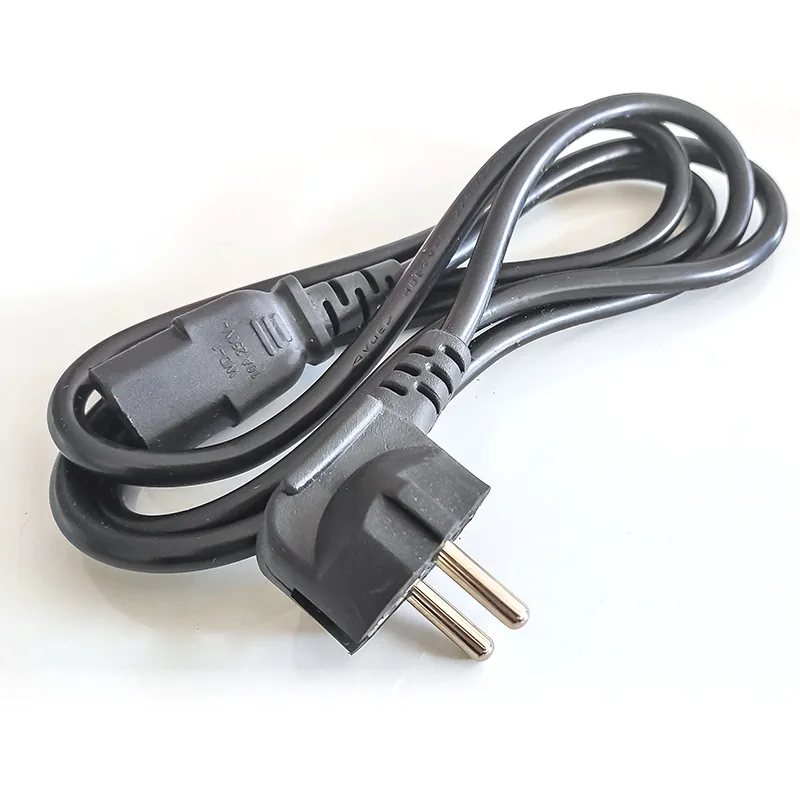
Our own EU plug to C13 desktop power cord is built as 3 × 0.3 mm² CCA in a 1.5 m length with an EU plug report on file, which suits desktop and monitor applications where the continuous load is modest. If your appliance pulls closer to the 10 A limit, or the inlet runs hot, the same moulding is quoted in a larger copper construction or as a C15 version - the coupler family is a specification input, not a catalogue default. The 12 V 6 A desktop power adapter is the other half of the same conversation for OEMs building a complete power package.
11. Conclusion: three questions before the purchase order
Before a coupler goes onto an order, three questions should have a written answer. What inlet is moulded into the appliance, and is it keyed? What current will the appliance draw continuously, and how hot does the inlet get in service? Which plug standard applies in the destination market, and which document proves it?
Get those three right and the rest of the specification follows: the coupler number, the pin temperature class, the conductor size, the cord type and the documents. Get them wrong and no amount of factory inspection will fix the order, because the part that does not fit was specified correctly against the wrong question. The five couplers in this guide are simple products; the discipline of specifying them is what separates a repeat customer from a claim.
Related power products from Vellygood
- EU Plug to C13 Desktop Power Cord — 3 × 0.3 mm², 1.5 m, EU plug report on file
- 12 V 6 A Desktop Power Adapter — 110–250 V input, LVD and EMC certified, customisable plug and output
- Copper vs CCA Conductors — how conductor metal changes resistance, heat and voltage drop
- Full product catalog — HDMI, USB, network, power, audio and VGA cable lines