
A purchase order arrives that reads, in full, “H05VV-F 3×1.5, black, 2 m”. Four things in that line are ambiguous and one of them is expensive. The “3×” says three cores and no earth, which is the wrong construction for an earthed appliance. Nothing states the rated voltage or the approval mark. Nothing states the temperature the cord will see. And 1.5 mm² is a cross-section, not a current rating, so the load it will actually carry depends on information that is not on the order. None of this is exotic. It is what happens when a designation system that was designed to be precise is used as if it were a product name.
The designation system itself is well documented. CENELEC introduced it so that a cable could be identified the same way in every European market, and it is set out in HD 361 and DIN VDE 0292, covering cables up to 450/750 V. Read as a positional code, H05VV-F answers four separate questions in five characters. Read as a word, it answers none of them.
The code is positional, so read it position by position
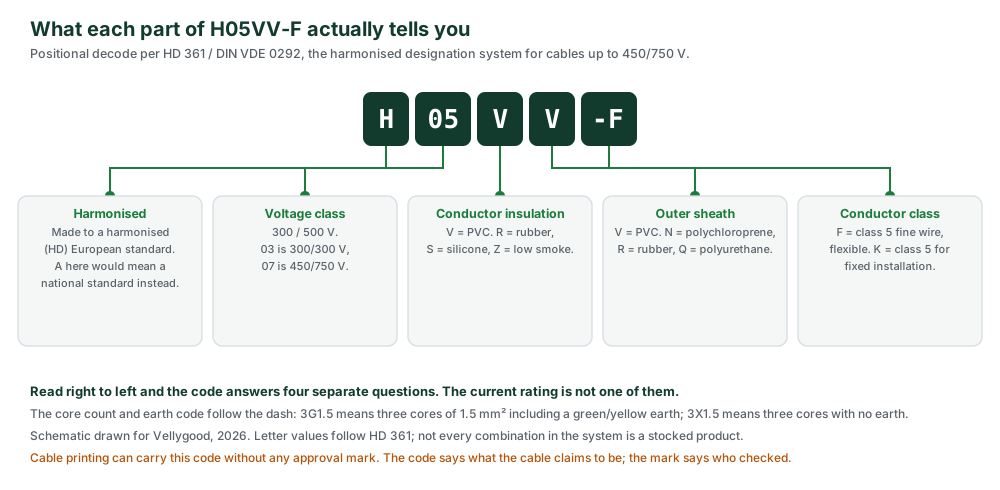
Work through it in order and the logic is straightforward. The leading H states that the cable is made to a harmonised European standard; an A in that position would mark a non-harmonised national type. The two digits that follow give the rated voltage class, and there are only four of them in general use: 01 for 100/100 V, 03 for 300/300 V, 05 for 300/500 V and 07 for 450/750 V. Then come two material letters, the first for the conductor insulation and the second for the outer sheath, drawn from the same value list: V for PVC, V2 for heat-resistant PVC, V3 for low-temperature PVC, V5 for oil-resistant PVC, R for standard rubber, N for flame-retardant polychloroprene, S for silicone, Q for polyurethane and Z for low-smoke cross-linked polyolefin.
After the materials comes the construction, and here the absence of a letter carries meaning: no construction letter means a round cable, while H, H2 and H6 mark flat non-separable constructions, with H6 used for flat cables of three or more conductors. Then a dash introduces the conductor itself. A dash with no additional letter means copper, and A means aluminium. The final letter states the conductor class — F for class 5 fine wire, H for class 6 extra-fine, K for class 5 wire intended for fixed installation, R for rigid multi-stranded and U for a single round wire.
| Position | Element | Values in common use | What it decides |
|---|---|---|---|
| 1 | Standard basis | H harmonised, A national | Whether the cable is claimed against an HD standard |
| 2 | Rated voltage | 01 = 100/100 V, 03 = 300/300 V, 05 = 300/500 V, 07 = 450/750 V | The voltage class the insulation is designed for |
| 3 | Conductor insulation | V PVC, V2 heat-resistant PVC, R rubber, S silicone, Z low smoke | Temperature ceiling and flexibility at the conductor |
| 4 | Outer sheath | V PVC, N polychloroprene, R rubber, Q polyurethane | Oil, weather, abrasion and flame behaviour |
| 5 | Construction | none = round, H / H2 / H6 = flat | Whether the cable will fit the moulding and strain relief |
| 6 | Conductor metal | dash = copper, A = aluminium | Conductivity, and whether the code is describing a copper product at all |
| 7 | Conductor class | F class 5 flexible, H class 6, K class 5 fixed, R rigid, U solid | Flex life and whether the cable is meant to move |
| 8 | Cores and earth | 3G1.5 = three cores with earth, 3X1.5 = three cores without | Whether a protective conductor exists at all |
Table 1 — the positional decode per HD 361 / DIN VDE 0292. Not every combination in the system is a stocked product; the table describes how to read a code, not what is available.
The codes that actually appear on enquiries
In practice most European power cord enquiries land on a small set. Knowing which three of these are genuinely interchangeable and which are not is most of the job.
| Code | Voltage class | Insulation / sheath | Construction | Where it belongs |
|---|---|---|---|---|
| H03VVH2-F | 300/300 V | PVC / PVC | Flat, two-core | Small Class II appliances, chargers, lamps |
| H05VVH2-F | 300/500 V | PVC / PVC | Flat, two-core | Double-insulated appliances on a two-pin plug |
| H05VV-F | 300/500 V | PVC / PVC | Round | The volume case: indoor appliance and IT cords |
| H05RR-F | 300/500 V | Rubber / rubber | Round | Flexible indoor use where PVC stiffness is a problem |
| H05RN-F | 300/500 V | Rubber / polychloroprene | Round | Medium-duty outdoor and workshop cords |
| H07RN-F | 450/750 V | Rubber / polychloroprene | Round | Site, industrial, outdoor and heavy handheld equipment |
| H07V-K | 450/750 V | PVC | Single core, no sheath | Panel and fixed wiring, never an appliance cord |
Table 2 — the seven designations that cover most enquiries. H07V-K is included because it is the one most often mistaken for a cord: it is a single insulated core with no outer sheath.
Five naming traps that reach the installation
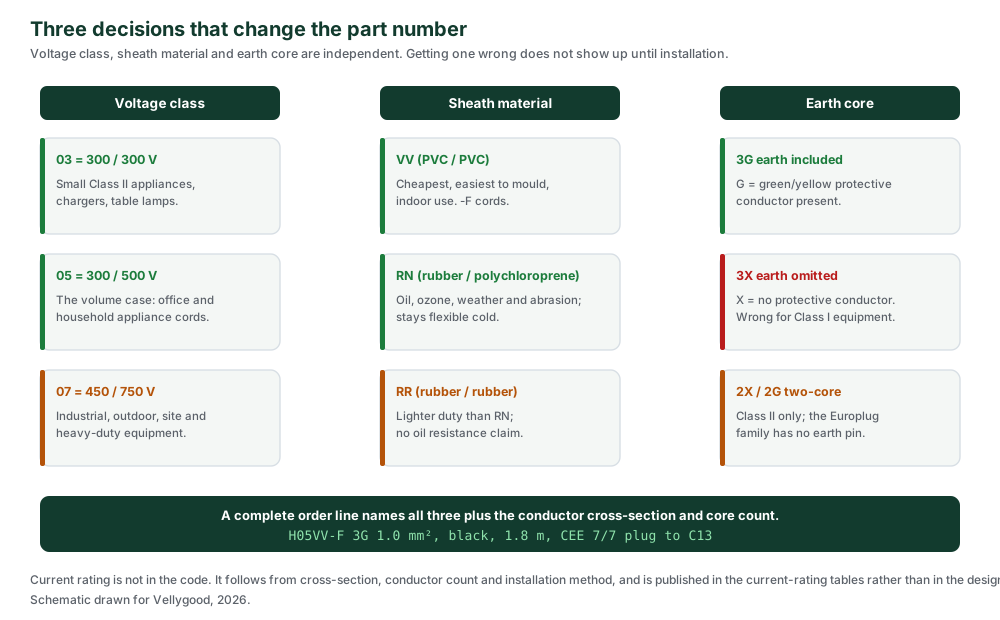
1. Three cores is not the same as three cores with an earth. In the code, the letter after the core count is the earth statement: G means a green/yellow protective conductor is present, X means it is not. A “3X1.5” cable has three cores and no earth, so a Class I appliance wired with it has no protective path however substantial the cable looks. This is the single most expensive letter on the order, because the fault is invisible during inspection and only appears when someone tests continuity.
2. The H2 construction is flat, and flat is not round. H05VV-F is round; H05VVH2-F is flat. They will not share a moulded plug, a strain relief, or a cable gland without rework. Buyers order the flat version for small two-core appliance cords without saying so, and the factory ships whichever shape the tool produces. If the moulding matters, the construction letter has to be on the drawing.
3. “Rubber” is a material family, not a code. R and N are different values from the same list, and they appear in two positions. H05RR-F is rubber insulation with a rubber sheath. H05RN-F is rubber insulation with a polychloroprene sheath, which is where the oil and weather resistance comes from. An order that says “rubber cable” leaves the sheath open, and the sheath is the part that decides whether the cord survives a workshop floor.
4. The designation and the approval mark are two different claims. A cable can be printed H05VV-F because that is what it is built to, while carrying no approval mark from a national body or the harmonised scheme. Both facts matter to a buyer, and only the second one is evidence that somebody outside the factory looked at it. When a supplier quotes “HAR cable”, ask which approval marks the reel and the test report actually carry.
5. A cross-section is not a current rating. The code ends with millimetres squared, and buyers routinely read 1.5 mm² as “16 A”, 2.5 mm² as “20 A” and stop there. Those figures come from current-rating tables under stated installation conditions — in free air, at a given ambient temperature, with a given number of loaded cores. Bundle the same cable in a conduit at 40 °C and the number changes. The code cannot derate itself.
PVC or rubber is an environment question, not a price question
H05VV-F and H07RN-F are not two grades of the same cord. The 05 and 07 digits put them in different voltage classes, 300/500 V against 450/750 V, and the material letters change both the insulation and the sheath. The practical difference is not the voltage headroom most buyers will never use. It is what the sheath does when the cable meets oil, sunlight, ozone, abrasion and a cold morning. Polychloroprene is chosen for exactly those conditions, and rubber-insulated construction stays flexible at temperatures where PVC has gone stiff.
The reverse decision is just as common and costs more money than it needs to. An indoor office or domestic appliance cord does not see oil, does not run outdoors and does not need to bend at −20 °C. Specifying RN construction there raises the price of every unit and buys a property the installation cannot use. The correct question is not “which is better” but “what does this cable meet in service” — and if the honest answer is a plastic floor and a desk, PVC is the answer.
Temperature: read the datasheet, not the code
Nothing in the designation states an operating temperature, which is why the figure gets copied from one quotation to the next without a source. It is worth knowing that reputable European datasheets do not agree with each other here. Manufacturer data for H05VV-F commonly quotes a maximum conductor temperature of 70 °C with a flexing range starting around −5 °C, and some datasheets for the same designation quote 60 °C instead. H07RN-F datasheets generally state −25 °C to +60 °C for flexible use, with an allowance up to 85 °C for fixed and protected installation, and a short-circuit allowance at the conductor.
For a buyer the conclusion is procedural rather than technical: the temperature figure has to come from the manufacturer's datasheet for the specific product, and it belongs on the purchase order as a stated requirement. If a cord is going into a heater, a lamp fitting or an enclosure that runs warm, that is the number that decides whether the cord is suitable, and it is not derivable from HD 361.
Current rating lives in a different document
Because the code says nothing about current, the capacity has to be established separately, from the current-rating tables that apply to the cable type and from the installation conditions. Three variables dominate: the conductor cross-section, how many cores are actually carrying load, and the ambient temperature around the cable. A three-core cord with one core carrying no current behaves differently from a three-phase cable with all cores loaded. A cable clipped in free air behaves differently from the same cable in a bundle inside a trunking.
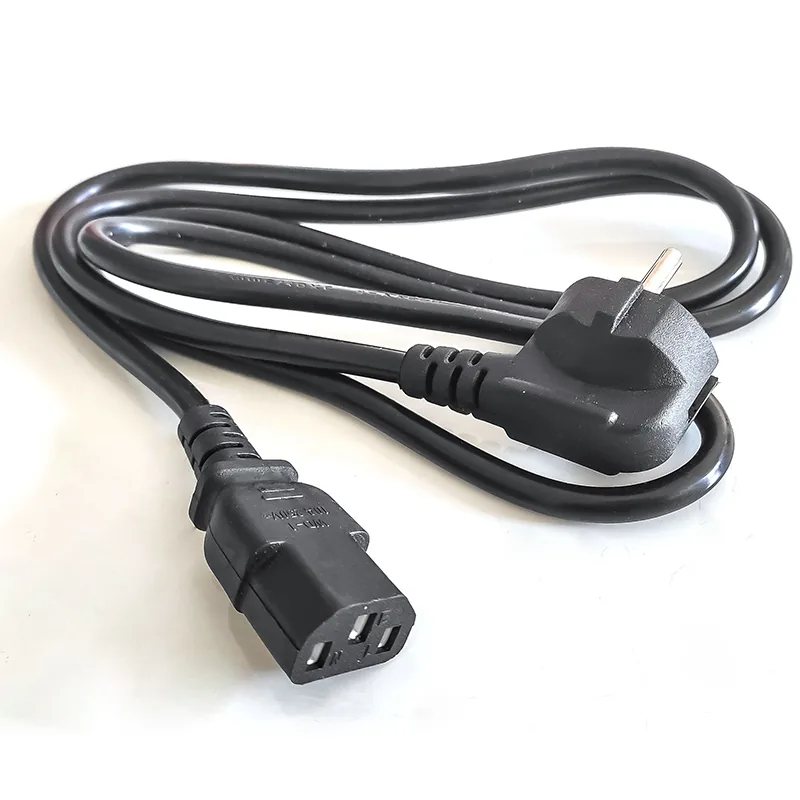
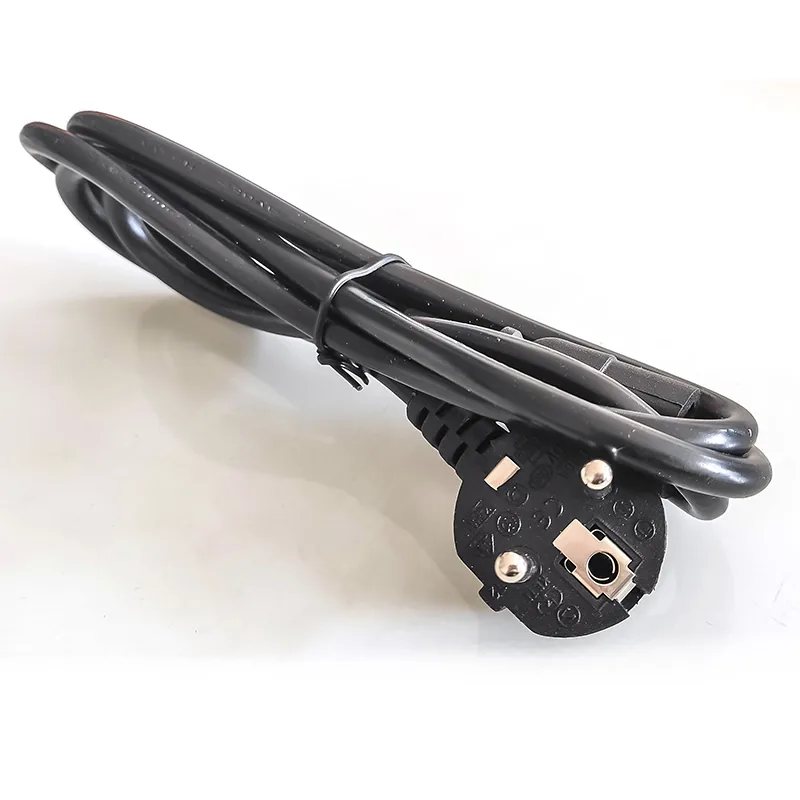
This is also why “what cord do I need for a 2 kW appliance at 230 V” has no answer that ignores the plug. The plug family caps the current independently of the cable — a Europlug is a 2.5 A device whatever cable is moulded onto it, and a CEE 7/7 plug is rated 16 A. The cable must be adequate for the load; the plug decides the ceiling. When the two are chosen at the same time, the answer is usually obvious. When the cable is chosen first and the plug added later, the smaller of the two silently becomes the limit.
Five mistakes and their consequences
1. Ordering 3X for an earthed appliance. Three cores, no green/yellow conductor. Consequence: no protective earth, whatever the appliance class requires. The cable passes a visual check and fails a continuity test.
2. Assuming 1.5 mm² means 16 A in every installation. The figure came from a table row with stated conditions attached. Consequence: a cord that is correct on paper and warm in a bundle, and a warranty argument nobody can win because the derating was never written down.
3. Using H07V-K as if it were a cord. Single core, no outer sheath, intended for panel wiring. Consequence: a product with no mechanical protection around the conductor insulation, which will not satisfy any appliance standard however good the copper is.
4. Specifying the flat construction by accident. The round code was written and the flat product was quoted, or the reverse. Consequence: the moulding, gland or strain relief does not fit, and the fix is a new tool rather than a new reel.
5. Treating the printed code as an approval. The jacket says H05VV-F and the file contains no approval mark and no test report. Consequence: the compliance claim cannot be evidenced when a customer, a marketplace or a customs officer asks for it.
What to put on the order
| # | Field | Usable example | Why it earns its line |
|---|---|---|---|
| 1 | Full designation | H05VV-F | Fixes voltage class, both materials and conductor class in one string |
| 2 | Cores and earth code | 3G, not 3X | Decides whether a protective conductor exists |
| 3 | Cross-section per core | 1.0 mm² | The input to the current-rating table |
| 4 | Load and installation conditions | 10 A continuous, free air, 30 °C ambient | Makes the current rating verifiable rather than assumed |
| 5 | Operating temperature | Maximum conductor 70 °C | Not in the code; must come from the datasheet |
| 6 | Construction | Round, not flat | Determines whether the moulding fits |
| 7 | Plug and connector | CEE 7/7 plug to IEC 60320 C13 | The plug caps the current independently of the cable |
| 8 | Length definition | 1.8 m, plug face to connector face | Removes the overall-versus-exposed length argument |
| 9 | Jacket colour and marking | Black, designation and metre marking printed | Printing is how the cable is identified after installation |
| 10 | Approval marks and test report | Marks stated, report per batch | Converts a claim into evidence |
Table 3 — ten fields that make a cable order inspectable. Fields 1, 2, 3 and 4 do the work; field 10 is what a compliance question will actually ask for.
FAQ
Is H07RN-F better than H05VV-F?
What does the G mean in 3G1.5?
Does the code tell me the current rating?
What is the difference between H05VV-F and H05VVH2-F?
Can a cable be printed H05VV-F without being approved?
Conclusion
A harmonised cable code is a compression format. Five characters carry the standard basis, the voltage class, two materials, the construction and the conductor class, and the suffix carries the core count, the earth statement and the cross-section. Everything it compresses is checkable, which is why the code is worth reading properly rather than copying from an old quotation. Everything it leaves out — operating temperature, current rating, approval marks — is exactly what a compliance question will ask for, and exactly what a purchase order has to state separately.
We build European power cords as named constructions rather than generic “EU cords”: H05VV-F and H05VVH2-F for the volume case, H05RN-F and H07RN-F where the environment demands it, each with the plug family specified independently and each shipped with the marks and the test report stated on the order. If you send us the designation, the core and earth code, the cross-section and the plug family, we can quote a buildable part; if any one of those four is missing, the quotation is a guess with a price attached.
The same positional logic runs through the rest of the range. Our EU power cord page carries the CEE 7/7 and Europlug constructions in round and flat build; the 12 V 6 A adapter page shows the low-voltage side where the cord is a fixed lead rather than a detachable one; and the CAT.6 patch cord page uses the same conductor-class distinction on a data cable. If you would rather check a code against a real datasheet than against a table, send us the designation and we will reply with the construction it commits us to.