
Every few weeks a purchase order arrives that says, in full, "Cat 6 FTP". Another says "Cat 6 STP". One said "Cat 6 SFTP", which is not a designation that appears in any cabling standard. All three describe cables that look different in cross-section, behave differently once the screen is or is not bonded, and cost different amounts to install. None of the three tells a factory precisely what to build.
This guide sets out the part that is written down in the standards, and the part that is engineering judgement. If you are specifying shielded cabling for a project, the order matters: read the designation correctly, decide from the environment rather than the category, and only then look at price.
1. The designation is a code, not a brand name
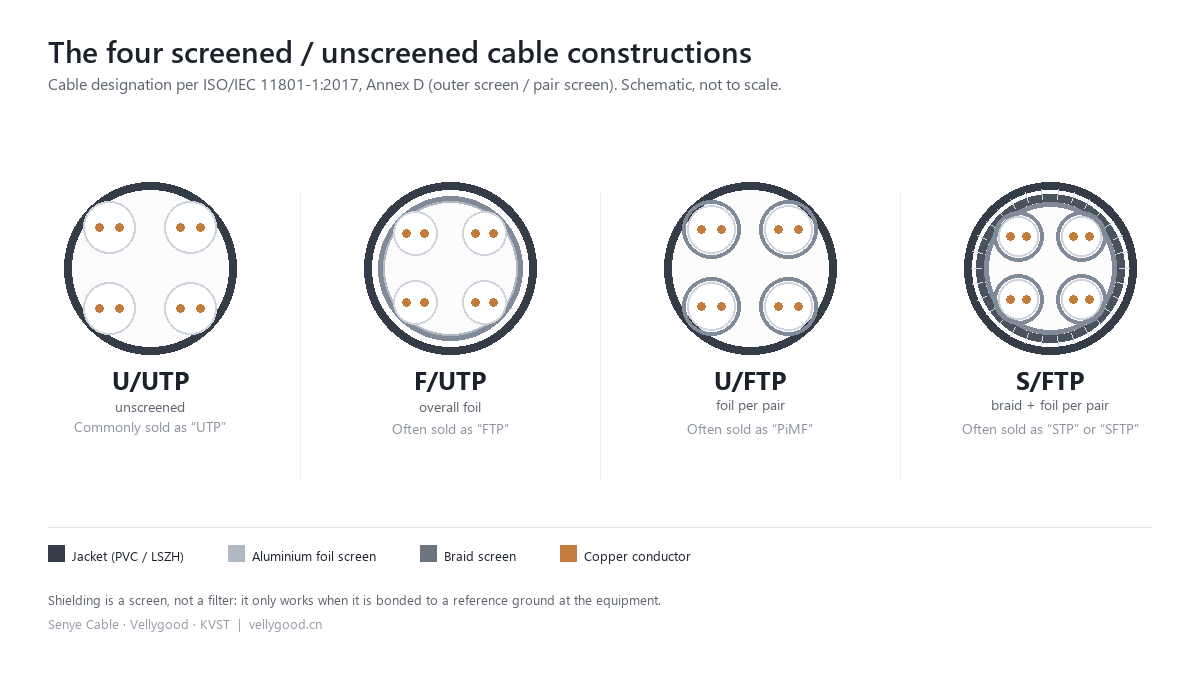
ISO/IEC 11801-1 defines a naming schema for balanced twisted-pair cable in Annex D, Figure D.1: an overall construction code, a slash, then the code for the element inside. U means unscreened, F means foil, S means braid, and SF means braid and foil together. TP at the end means twisted pair.
That is the whole system. Once you read the two positions separately, the trade names stop being confusing:
| Designation | Overall screen | Screen per pair | Usually sold as |
|---|---|---|---|
| U/UTP | None | None | UTP |
| F/UTP | Foil | None | FTP, F-STP |
| U/FTP | None | Foil | PiMF, SSTP |
| S/FTP | Braid | Foil | STP, SFTP |
| SF/UTP | Braid and foil | None | SF/UTP, sometimes STP |
The standard itself lists the first, second, fourth and fifth of these with their common aliases in the informative examples beside Figure D.1, and shows U/FTP in the cable-type drawings of Figure D.2. So "FTP" is not a separate product family; it is what the market calls F/UTP.
Two practical consequences follow. A screen on the inside of the jacket and a screen around every pair do different jobs: the overall screen keeps outside fields away from the cable, while a per-pair foil limits coupling between the pairs inside the same jacket. And the letters are ordered, not decorative. S/FTP is braid outside plus foil per pair. SF/UTP is both screens outside and bare pairs inside. Removing one slash changes what the factory has to build.
2. The naming traps that cost money
STP does not exist in the designation system. It is a trade abbreviation, and different suppliers use it for at least three different builds: an F/UTP with a foil overall, an S/FTP with a braid, and sometimes any cable with a metal-shell plug. If a buyer asks for "STP" and a factory quotes an F/UTP, nobody is lying and the result is still wrong. Write the ISO designation into the order and the ambiguity disappears.
SFTP and S/FTP are not the same cable. The missing slash is the difference between foil around each pair (S/FTP) and no pair screen at all (SF/UTP). We have seen both spellings used for the same part number in the same catalogue.
"Cat 7" is an ISO designation, not a TIA one. Cat 7 (Class F, 600 MHz) and Cat 7A (Class FA, 1,000 MHz) are recognised by ISO/IEC 11801 but do not appear in the TIA-568 category series, which is why the North American standard skips from Cat 6A to Cat 8 (Ampcom, July 2026; Black Box). That matters at the connector: most "Cat 7" patch cords on the market are terminated with ordinary RJ45 plugs, an interface that was not part of the original Class F channel definition. A cable test report does not prove a channel. If a project genuinely needs Class F or FA, ask for a channel test on the exact connector set, or accept that what you are buying is a 600 MHz cable terminated on a Cat 6A-style interface.
"Shielded" is not a performance grade. It says nothing about category, conductor, or whether the screen will be bonded at both ends. Those three variables decide the outcome.
3. Unshielded is not one thing either
The second half of the decision is category, and it is independent of the screen. ISO/IEC 11801-1 sets the classes: Class D to 100 MHz, Class E to 250 MHz, Class EA to 500 MHz, Class F to 600 MHz and Class FA to 1,000 MHz, all within a 100 m channel.
The detail that surprises buyers is alien crosstalk, the interference between neighbouring cables in the same bundle. In ISO/IEC 11801-1 the alien crosstalk requirements apply to Classes EA, FA, I and II only. Class E, which is Cat 6, carries no alien crosstalk requirement at all, and the standard notes that Class F alien crosstalk performance is treated as equivalent to Class EA. That single sentence explains the familiar advice about 10GBASE-T: the full 100 m channel needs Class EA (Cat 6A), while Cat 6 is commonly quoted for shorter runs, around 55 m, depending on how the bundle is built. The 55 m figure is vendor guidance rather than a number written into the class table, so treat it as engineering practice and confirm the reach for your own bundle with the switch vendor.
The point for a purchase order: buying a screened Cat 6 cable does not turn it into Cat 6A. Screens address interference from outside the cable; alien crosstalk is interference from the cable next to it, and it is solved by category and by installation practice, not by foil.
4. What a screen actually buys: coupling attenuation
Shielding performance is not measured by how shiny the foil looks. ISO/IEC 11801-1 measures it as coupling attenuation, defined in the vocabulary clause as the ratio, in decibels, of the differential power in the signal pairs to the power generated by the excited common-mode currents. In plain terms: how much of the wanted differential signal stays inside the cable, instead of converting into a common-mode current that runs on the outside of the screen and radiates.
The critical design detail is in clause 6.3.3.12.4. The minimum coupling attenuation requirement applies to a channel "that is intended to be subjected to an environmental classification Er". The requirement is tied to the environment, not to the category. That is the technical reason why the honest answer to "do I need shielded cable" is a question about the building, not about the bandwidth.
The environment rating comes from the MICE scheme in the same standard: mechanical, ingress, climatic and electromagnetic, each graded 1 to 3. A typical office space sits at the lowest grade, E1. Table 29 then gives the minimum coupling attenuation:
| Frequency | E1 (office) | E2 (light industrial) | E3 (heavy industrial) |
|---|---|---|---|
| 30 MHz to 100 MHz | 40 dB | 50 dB | 60 dB |
| Above 100 MHz | 80 - 20 log f | 90 - 20 log f | 100 - 20 log f |
| At 250 MHz | 32.0 dB | 42.0 dB | 52.0 dB |
| At 500 MHz | 26.0 dB | 36.0 dB | 46.0 dB |
The curves fall with frequency, so the gap between classes widens as bandwidth rises. At 500 MHz a heavy industrial environment demands roughly 20 dB more coupling attenuation than an office. That is a factor of ten in power: the kind of margin an overall foil alone will not deliver, and the reason S/FTP is the usual answer next to drives, inverters and welding equipment.
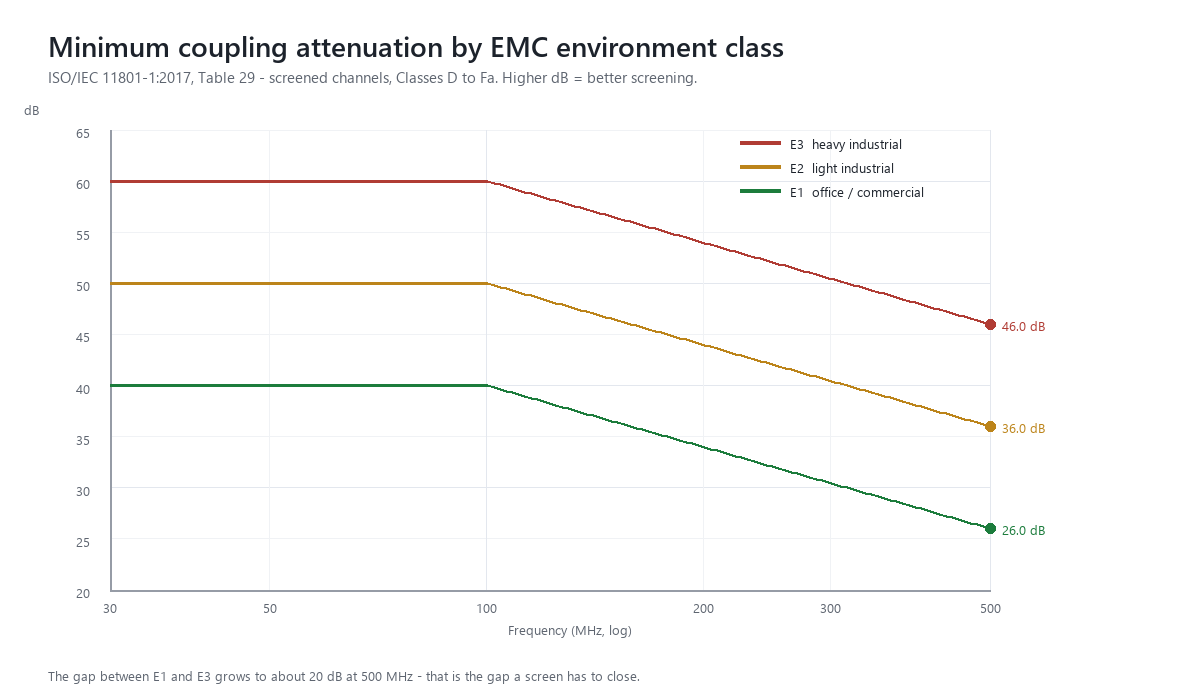
One more sentence from the standard is worth repeating to any buyer who asks why the far end of a run matters: different locations within a channel can be subject to different environments, so the description of the channel has to be divided up accordingly. A run that leaves an office and enters a machine hall is an E3 run at one end and an E1 run at the other. The screen has to satisfy the harsher end over the whole length.
5. Where screens go wrong: bonding, not foil
A screen is a conductor wrapped around the pairs. Left floating, it is an antenna: it picks up the field, and instead of shunting it to earth it re-radiates it into the pairs it was meant to protect. This is the single most common way shielded cabling makes a network worse than unshielded cabling would have been.
North American guidance is consistent about the fix. TIA standards and BICSI recommendations bond shielded cabling at both ends, through shielded patch panels, shielded termination hardware and shielded patch cords, with a bonding impedance of 100 milliohms or less (TrueCable, September 2023). The engineering assumption behind that number is that the two ends sit on an equalised ground path.
Industrial practice often reads the same problem the other way. Where cabinets sit on different earthing systems and a potential difference exists between them, the screen becomes the bridge carrying that difference, and the recommendation from some field engineers is to bond the screen at the source end only: the PLC end of a Profinet run, the drive end of an EtherCAT link. The same source notes that the screen raises cable capacitance, which acts as a low-pass filter and eats into reach at long distances, and that shielded twisted pair costs roughly four times as much as UTP (Control Design, January 2021).
Both positions are defensible, and they share one precondition: somebody checked the potential difference and wrote down the bonding plan. A shielded system without a bonding plan is not a shielded system. What has to be shielded as well, and is routinely forgotten:
- the keystone jacks or panels, which must have a metal housing that contacts the foil or drain wire;
- the patch cords at both ends, or the screen stops at the first plug;
- the rack or enclosure earth, verified with a continuity meter rather than assumed;
- the cable tray crossing, where a run leaves a screened pathway.
6. Cost and handling, in the numbers buyers ask about
Shielded cable is a different product to handle, not a premium version of the same one. Three costs move together: the cable, the termination and the space it needs.
The cable itself is the smallest of the three. Shielded twisted pair is commonly quoted at around four times the cost of the equivalent unshielded construction (Control Design, January 2021). The termination is where projects lose time: a shielded plug has a metal shell, a fold-back foil or a drain wire that has to be dressed, and an installer who has to get the pair untwist right as well. Volume quotes should be asked for on both constructions, because the labour difference is often larger than the material difference.
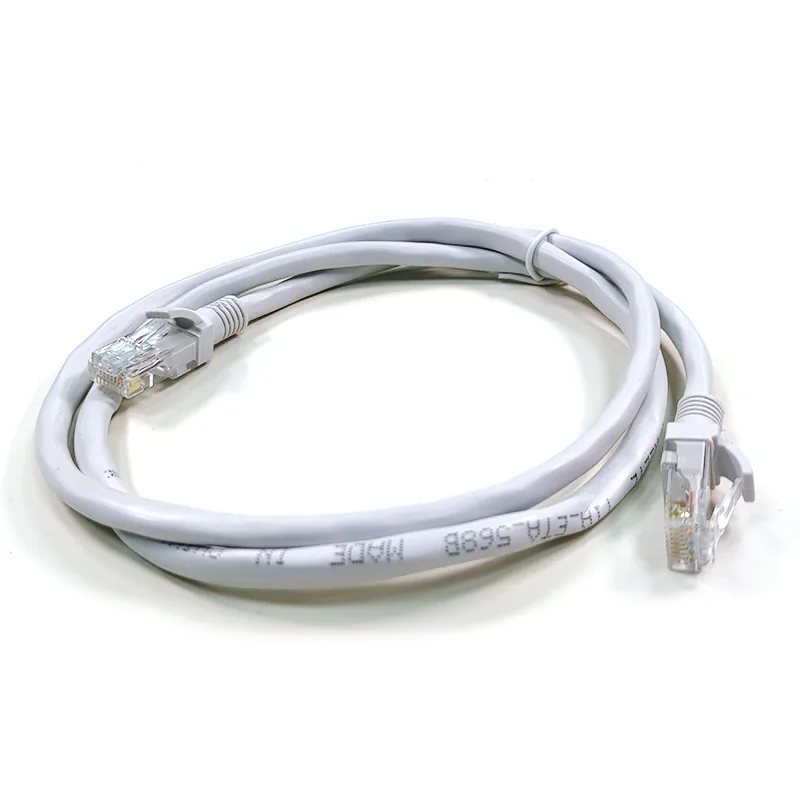
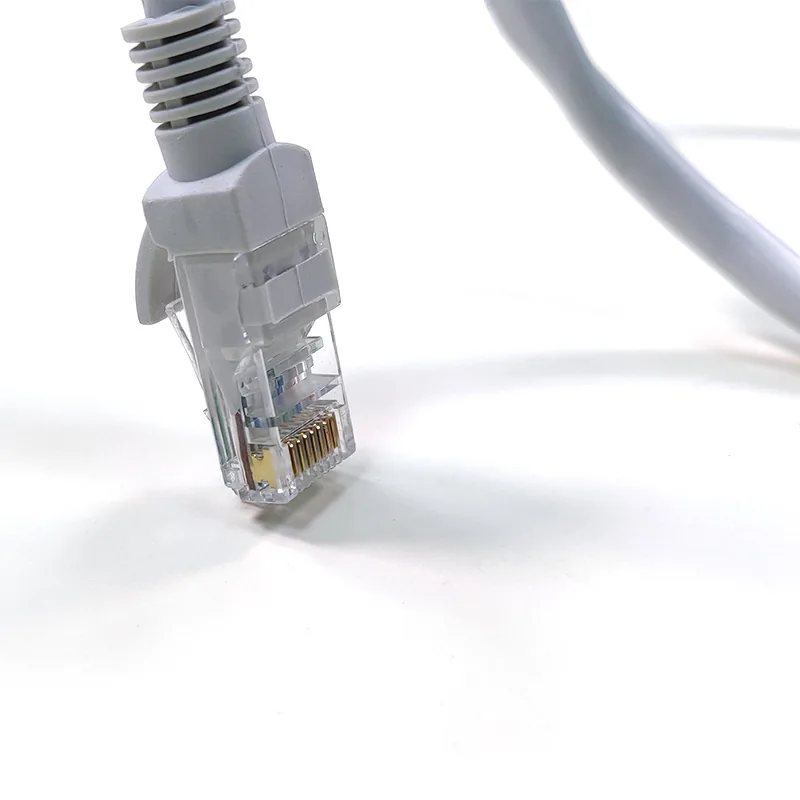
Then there is diameter. Our own stock Cat 6 UTP patch cord is built on a 6 x 0.12 mm CCA conductor inside a 5.9 ± 0.2 mm PVC jacket, in light grey; it is the model that most of our OEM customers start from. A screened S/FTP build of the same category needs a foil per pair, a braid, a drain path and a metal-shell plug, and the outside diameter grows. That changes the mould, the strain relief, the bend radius and the carton count. If a project has conduit fill or a fixed bend radius, check the diameter before you commit to the screen, not after.
7. A selection table you can quote from
| Situation | Reasonable starting point | Reason |
|---|---|---|
| Office LAN, 1 GbE, normal ceiling voids | U/UTP Cat 6 | E1 environment; no bonding to maintain; lowest installed cost |
| Office LAN, 10GBASE-T to the full 100 m | U/UTP Cat 6A | Class EA bandwidth and alien crosstalk limits; the screen is not the constraint |
| Shop floor with drives and inverters nearby | F/UTP or U/FTP | E2 coupling attenuation of 50 dB at low frequency, 36 dB at 500 MHz |
| Beside VFD output cables, welding, large contactors | S/FTP with a full bonding plan | E3 needs 60 dB at low frequency and 46 dB at 500 MHz |
| Between buildings, or any run with a large earth potential difference | Fibre | Galvanic isolation; no bonding question to answer |
The table is a starting point, not a substitute for the site survey. The one row that is not negotiable is the last: if the reason for considering a screen is a difference in earth potential between two structures, a copper screen is the wrong tool.
8. What to put in the purchase order
Most quality disputes on network cable are specification disputes, and they are cheap to avoid. Eight lines do most of the work:
- The ISO designation. Write "S/FTP" or "F/UTP", not "STP" or "SFTP".
- Category and class. For example "Cat 6A, Class EA, 500 MHz".
- Conductor. Solid or stranded, AWG, and copper or CCA, stated explicitly.
- Jacket. PVC or LSZH, colour, and the outside diameter with its tolerance.
- Screen construction. Foil overall, foil per pair, braid coverage if a braid is specified, and drain wire.
- Test report. Channel or permanent link, the standard it is tested to, and the tester model. A cable-only report does not cover the plugs.
- Bonding accessories. Shielded jacks, panels and patch cords quoted on the same order, or the screen will be broken at the ends.
- Jacket marking. The designation, category, length and manufacturer code printed on the cable, so the next contractor can identify it.
9. Five mistakes we see in real projects
Shielded cable into unshielded jacks. The most expensive version of a false economy. The material premium is paid and none of the coupling attenuation benefit is delivered, because the screen terminates in mid-air behind the wall plate.
"Cat 7 means faster." Category sets bandwidth; the screen sets immunity. A 600 MHz cable on an RJ45 interface still has to pass a channel test before anyone can call it Class F.
Ordering "STP" and hoping. Two suppliers will read it two ways. The invoice will look right and the delivered cable may be the other construction.
Ignoring the bundle. In a dense tray, alien crosstalk between cables can dominate. That is a category and installation question; no amount of foil per pair fixes a bundle that should have been Cat 6A, or spaced.
Treating one end's environment as the whole channel. If the run leaves the office and crosses the plant, the harsher environment governs the specification for the whole length.
Conclusion: screen for the environment, category for the bandwidth
Two decisions, taken in order, settle almost every case. First, what is the electromagnetic environment along the run: E1, E2 or E3? That decides whether a screen is required at all, and how much coupling attenuation it must deliver. Second, what bandwidth has to reach how far? That decides the category, and no screen substitutes for it.
Then one installation question decides whether the money was well spent: is there a bonding plan, with shielded jacks, panels and patch cords on the same order, and a measured earth at both ends? If the answer is yes, a screened system behaves as specified. If the answer is no, the unshielded alternative was the better purchase.
If you are sourcing network cable for a project and the specification still says "FTP" or "STP", send it over. We will read it as a construction, tell you which ISO designation it actually corresponds to, and quote both the screened and the unscreened option against the environment you describe.